


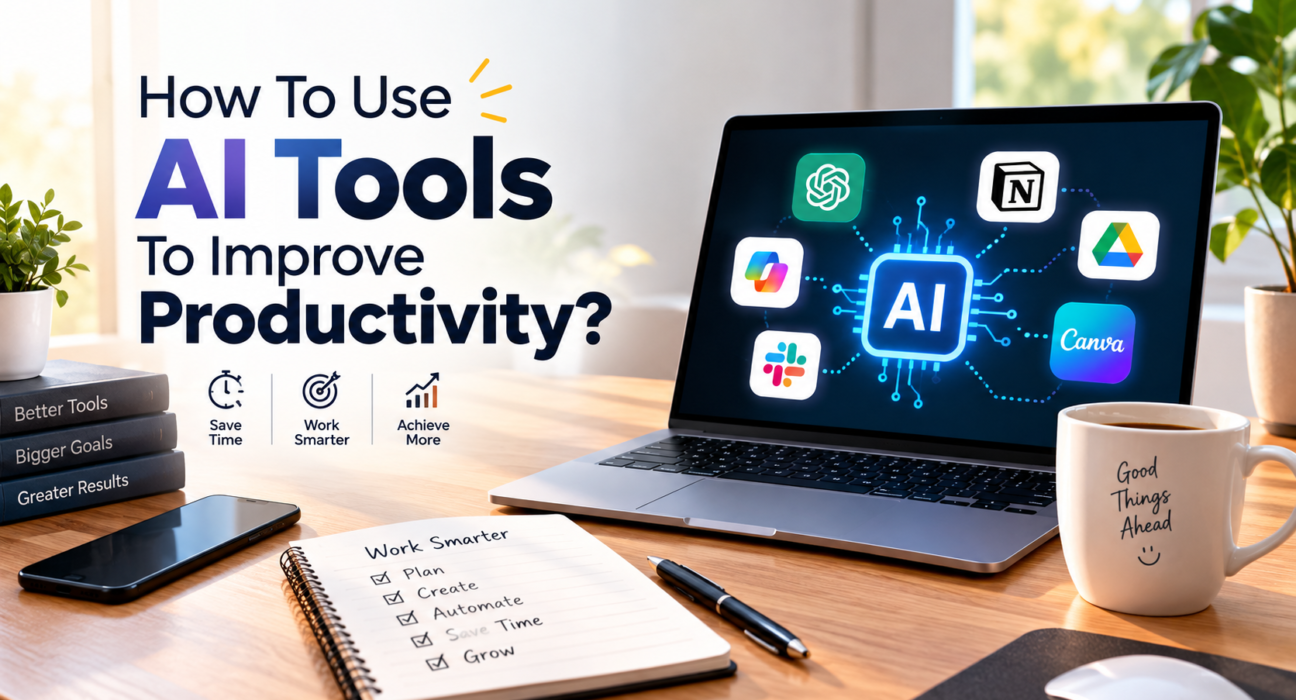
Artificial intelligence tools are becoming useful assistants for students, freelancers, content creators, and businesses. They can help people organize information, generate ideas, summarize documents, and complete certain repetitive tasks more efficiently.
However, productivity is not simply about completing more tasks. It also involves producing accurate work, prioritizing important activities, and using time wisely.
In this guide, we explore practical ways to use AI tools for productivity while maintaining quality, privacy, and human judgment.
1. Use AI for Research and Brainstorming:
Starting a project can be difficult when you do not know where to begin. AI tools can help generate ideas, suggest questions, and organize a topic into smaller sections.
For example, a blogger can ask an AI assistant to suggest article angles for a particular audience. A business owner can use it to brainstorm potential customer questions.
Treat generated ideas as starting points. Verify factual claims with reliable sources, especially when writing about technical subjects, financial matters, or current developments.
2. Improve Content Planning:
Content creators can use AI to develop outlines, organize related topics, and create editorial calendars.
A useful workflow is to define the audience, identify the purpose of the article, research the subject, and then use AI to help organize the material.
The final content should include original insights, accurate information, clear explanations, and practical value. Publishing large amounts of unreviewed, repetitive content is not a substitute for quality.
For related marketing ideas, explore our guide to digital marketing strategies.
3. Automate Repetitive Tasks:
Some AI-enabled tools can help summarize meeting notes, categorize information, draft routine messages, or organize customer inquiries.
Automation works best when a task is repetitive, its rules are clear, and the results can be checked. Before automating a process, identify what success looks like and decide when a human should review the output.
Do not automatically trust generated results simply because they were produced quickly.
4. Use AI for Learning:
AI assistants can explain unfamiliar concepts, provide practice questions, and break complicated topics into simpler steps.
For example, someone learning software development can request an explanation of a programming concept or ask for a small example. The learner should then test the code, read official documentation, and understand how the solution works.
AI is most useful as a learning companion when it encourages understanding instead of replacing it.
5. Support Business Decisions Carefully:
Businesses can use AI tools to organize feedback, summarize research, and explore possible approaches to a problem.
However, important decisions should not rely solely on AI-generated recommendations. Outputs may contain errors, reflect incomplete information, or overlook the needs of specific customers.
Combine AI assistance with reliable data, professional knowledge, and human judgment.
6. Protect Privacy and Sensitive Information:
Before using an AI service, review its privacy settings, data handling practices, and terms of use.
Avoid entering passwords, confidential customer records, payment details, private business documents, or other sensitive information unless the service is approved for that purpose and appropriate safeguards are in place.
Businesses should establish clear rules for which tools employees may use and what information they may share.
7. Choose the Right AI Tool:
Different tools are designed for different tasks. Some focus on writing and research, while others specialize in coding, image creation, transcription, or workflow automation.
When comparing options, consider accuracy, ease of use, privacy, integrations, cost, and the amount of human review required.
Start with a specific problem instead of subscribing to multiple tools without a clear purpose.
Conclusion:
AI tools can support productivity by helping with research, planning, learning, and repetitive tasks. Their effectiveness depends on how thoughtfully they are used.
Set clear goals, verify important information, protect sensitive data, and review the quality of the results. When combined with human expertise and responsible decision-making, AI can become a useful part of a modern workflow.